IRS’s Inaugural CEO: Dimon Ally Tackles $5T Tax Challenge
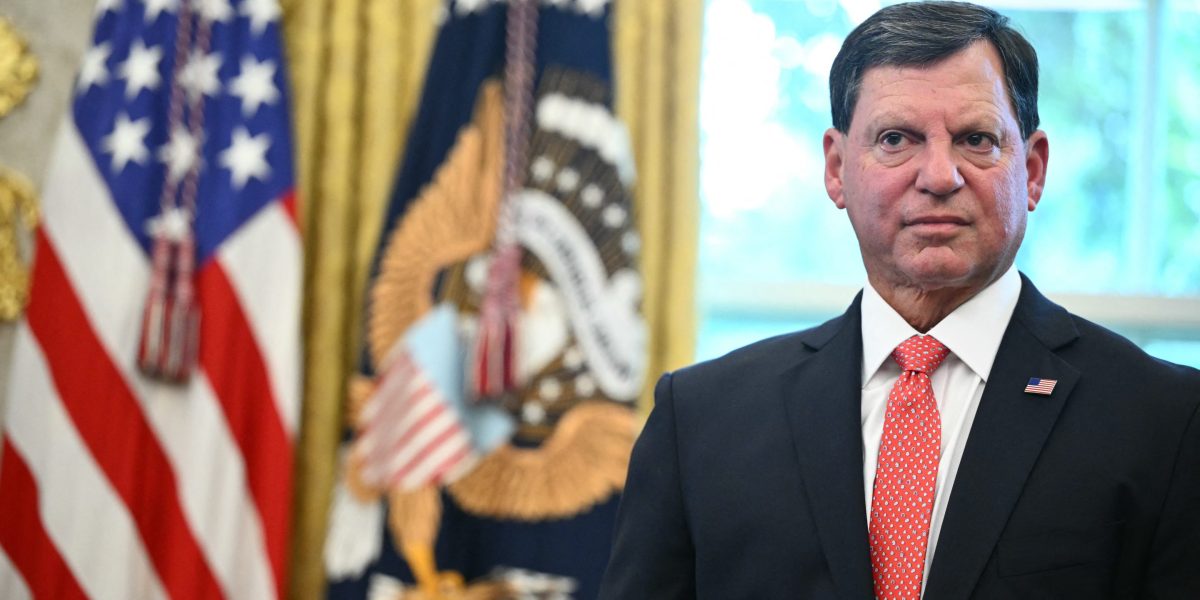
Frank Bisignano’s mobile phone suddenly buzzed, displaying a familiar number. It was the president calling. On that crisp morning in early October, the recently confirmed commissioner of Social Security sat in his expansive 40th-floor office in Manhattan’s Tribeca neighborhood, enjoying a panoramic vista stretching across the Lower East Side and into Brooklyn, the very place where he was raised in a working-class household by a father who dedicated 44 years to service as a customs agent and a mother who managed a stevedoring business.
‘The president, along with my superior, Treasury Secretary Scott Bessent, were in the Oval Office at the time,’ Bisignano remembers. ‘The president informed me that it was Scott’s strong suggestion for me to take on the role of the IRS’s very first CEO as well.’ Bisignano responded without hesitation, ‘Yes, I’ll take on whatever you need.’ The president replied that he was relying on Bisignano to ‘make the IRS great again,’ echoing the mandate he had already given for transforming Social Security.
These simultaneous leadership positions position Bisignano as arguably the most powerful back-office executive in recent American history. He now directs the globe’s largest retirement system, disbursing $1.5 trillion annually to more than 70 million recipients, alongside the world’s premier tax collection entity, which gathers over $5 trillion in yearly revenues that finance more than 90% of the federal government’s activities.
Bisignano represents a rare breed for both organizations—one not seen in ages, if at all: a high-profile private-sector chief executive applying his expertise in corporate turnarounds to these public institutions. As a hands-on operator rather than a traditional bureaucrat, he is deploying his proven restructuring strategies to entities with combined annual budgets exceeding $30 billion and a combined staff of approximately 150,000 employees, both notorious for desperately needing enhancements in operational efficiency and customer support. Persistent problems like delayed tax refunds from the IRS, protracted disability claim decisions at the Social Security Administration, and excessively long wait times on phone lines for both have fueled widespread public frustration, reinforcing the notion that government services are ineffective. Unlike his immediate predecessors, none of whom boasted substantial experience managing large-scale businesses, Bisignano brings a wealth of such credentials.
A close ally and protégé of Jamie Dimon, Bisignano forged one of Wall Street’s most distinguished careers by developing and optimizing critical yet unglamorous, technology-intensive operations such as payment networks and treasury management services. He entered the current administration following his tenure as CEO of Fiserv, the massive credit card payment processor. Notably, Fiserv’s stock value has declined significantly since his departure in May, with his leadership drawing criticism from his successor, Mike Lyon.
Juggling multiple high-stakes roles is familiar territory for him. ‘Folks often inquire, “How do you manage two jobs simultaneously?”‘ Bisignano shared during an exclusive interview with Fortune on January 18, from the same Tribeca office where he received the pivotal call from the president. ‘I don’t perceive it that way. Back at Citigroup, I simultaneously served as deputy head of operations and technology, while also acting as chief administrative officer for the world’s leading global and investment bank. Later, under Jamie Dimon at JPMorgan, I functioned as co-chief operating officer and oversaw the mortgage remediation initiative, which culminated in a $26 billion federal settlement in 2012 that revitalized the housing sector.’
In an administration populated by several former corporate heavyweights—including Howard Lutnick as Commerce Secretary, Doug Burgum as Interior Secretary, and Kelly Loeffler heading the Small Business Administration—Bisignano stands out with the most substantial leadership experience at the highest levels of major corporations.
Today, he is implementing the identical digital-prioritizing methodology, strict key performance indicator frameworks for leadership teams, and intensive personnel development tactics that propelled his successes in the private sector to both the Social Security Administration and the IRS.
However, intense scrutiny now falls on his management of the impending tax filing period, which is poised to unleash an unprecedented flood of refunds alongside major revisions to the tax code that will render processing returns significantly more intricate than in prior years. President Trump and Treasury Secretary Bessent have repeatedly highlighted how the One Big Beautiful Bill will deliver substantial cash returns to taxpayers, fully aware that any IRS missteps—such as postponed payouts or erroneous underpayments—could erode much of the anticipated public support.
Bisignano’s Rapid Progress at Social Security Surprised Even Elizabeth Warren, Signaling Big Gains Ahead for the IRS
Before Bisignano assumed leadership, the Social Security Administration experienced a rapid succession of four commissioners and acting commissioners from December 2023 through his Senate confirmation on May 6. These short-lived tenures stemmed partly from relentless congressional criticism regarding the agency’s subpar telephone and in-person support for beneficiaries. Under Bisignano’s brief but impactful stewardship, a host of performance metrics have shown remarkable progress. The agency’s website now operates 24/7, a stark improvement from its previous downtime of 29 hours weekly, or 17% of total time. Average phone hold times have plummeted: from 20 minutes in June of the prior year to a record low of seven minutes by September. Remarkably, the phone lines managed 68 million calls in fiscal year 2025, representing a 67% increase over fiscal year 2024. During the government shutdown, Bisignano ensured continuity in application and appeals processing, even incentivizing overtime work around Christmas—a federal holiday—with 66% staff participation. Another key achievement involved redesigned workflows that shortened disability claim processing from 240 days to 209 days, while slashing the backlog from 1.26 million to 865,000 cases.
In a July meeting, Senator Elizabeth Warren reportedly voiced skepticism over the data presented by Bisignano and his team, which demonstrated swift and significant reductions in wait times for the national SSA 800 hotline, as noted in an SSA press release. They mutually agreed to an independent verification by the Office of the Inspector General. The OIG’s December 22 report validated Bisignano’s claims, stating: ‘The SSA’s publicly reported metrics were accurate, and its overall telephone performance improved during FY 2025.’
Bisignano’s Career Climb as a Premier Corporate Fixer for Sandy Weill, Jamie Dimon, and Henry Kravis
The grandson of Italian immigrants, Bisignano honed his competitive edge at Baker University, a liberal arts institution in Kansas, where he earned national recognition and trophies as a top-ranked bowler. His major career launch occurred in 1994 when Jamie Dimon recruited him to oversee securities operations at Travelers’ Smith Barney division. There, he led a spirited softball team of Italian Americans called ‘the Paisanos,’ who playfully wore floppy pizza-maker hats during games. As Dimon and Sandy Weill pursued an aggressive acquisition strategy that birthed the behemoth Citigroup, Bisignano’s responsibilities in information technology expanded dramatically; by mid-2001, he was directing 16,000 employees in lower Manhattan.
On September 11, 2001, as the Twin Towers were engulfed in flames, Bisignano sprang into action on the streets below, megaphone in hand, directing, ‘Head north!’ He then shepherded thousands of Citigroup staff to a backup operations facility near Penn Station, maintaining the bank’s critical computing systems operational amid the ensuing weeks of turmoil.
In 2002, Bisignano was tasked with revitalizing Citigroup’s struggling Global Transactions Services unit, which was hemorrhaging $3 billion annually. He reimagined it as a comprehensive outsourcing hub for multinational corporations’ foreign exchange and accounting needs. Within just three years, the division swung to over $1 billion in profits—a turnaround that sustains it as a cornerstone profit center for Citigroup even today. Late in 2005, the returning Dimon convinced Bisignano to join JPMorgan as chief administrative officer. Dimon later tapped him to overhaul the toxic mortgage portfolio inherited from Washington Mutual, the subprime lender JPMorgan acquired under government direction during the Global Financial Crisis.
For the WaMu project, Bisignano commuted daily by air to California, returning to New York evenings for chemotherapy treatments addressing throat cancer, which he attributes to exposure from toxic 9/11 debris. The raspy timbre of his voice endures as a remnant of the life-saving surgery. Dimon also entrusted him with merging Bear Stearns into JPMorgan following its $250 million acquisition—a steal that included Bear’s full operations and its lavish 47-story headquarters, valued at $1.1 billion, which JPMorgan leadership utilized for years during their Park Avenue headquarters build-out.
In 2013, KKR co-founder Henry Kravis and then-top executive Scott Nuttall (now co-CEO) brought Bisignano on board to rescue First Data, widely regarded as the private equity firm’s most troubled major investment—a beleaguered credit card processor. Bisignano revolutionized its rudimentary card-swipe devices into sophisticated Clover countertop terminals equipped with analytics for inventory control, staff performance insights like identifying top wine salespeople, and prompts to upsell premium vintages to repeat high-end customers. In 2019, he orchestrated First Data’s sale to Fiserv, forging a payments powerhouse with over $20 billion in annual revenue, ownership of 6 million terminals globally, and handling 44% of U.S. credit card transactions. Subsequently, outreach from President Trump and Bessent identified Bisignano’s track record—architecting two of America’s premier banks and spearheading leaders in the cashless payment revolution—as perfectly suited to tackling the SSA and IRS challenges.
The 2025 Tax Filing Season Poses a Pivotal Challenge for Bisignano
Prior to Bisignano’s involvement, the IRS endured an astonishing five acting commissioners since President Trump’s inauguration, surpassing even the SSA’s instability. Trump crafted a decisive fix by first appointing Bessent as acting commissioner, then inventing the CEO role and selecting Bisignano. This designation unmistakably positioned him to manage the IRS’s daily operations. ‘Scott was enthusiastic about the CEO concept,’ Bisignano affirms.
‘This will mark the most critical tax season in history,’ the new CEO asserts, a view echoed by Trump and Bessent, with the president recently proclaiming it ‘the biggest tax season of all time!’
Trump and Bessent are heralding substantially larger refunds for far more Americans this year compared to last. As Bessent puts it, expect ‘a gigantic refund year.’ Recent statements from him project an extra $1,000 on average for wage earners in 2025, with the IRS issuing roughly $150 billion more in total refunds than in 2024—a 45% jump. These projections suggest around 150 million refund recipients this year, up from 104 million in 2024.
What drives this exceptional refund bounty for 2025 tax returns? Two primary dynamics are at play. Firstly, the One Big Beautiful Bill introduced a suite of novel tax incentives, including deductions up to $25,000 for tips and $12,500 for overtime earnings. Buyers of U.S.-assembled new vehicles financing via loans can deduct $10,000 in interest. Seniors 65 and older gain an extra $6,000 deduction. The state and local tax deduction ceiling rises from $10,000 to $40,000. The standard deduction climbs by $750 to $31,500, while the child tax credit expands from $2,000 to $2,200. Each provision includes income-based phaseouts. Additionally, the IRS will roll out Form 4547 to facilitate ‘Trump Accounts,’ the OBBB-created tax-advantaged savings options for children.
Secondly, although Trump enacted the OBBB on July 4, its benefits cover the entire 2025 tax year. Yet, the 2024 withholding tables remained unchanged, meaning workers overpaid into the system throughout the year and stand to reclaim those excess funds now.
Bisignano underscores that information technology, rather than workforce expansion, holds the key to superior, swifter service at both agencies—and at the IRS, to not only prompt refunds but optimized collections. He notes that President Biden’s proposed addition of 87,000 agents to boost enforcement never materialized under Trump. ‘Our framework guarantees we collect every appropriate dollar feasible,’ Bisignano explains. ‘We operate the leanest IRS ever. Our strengths lie in technology and personnel, synergistically applied—tech optimizes human deployment. For these organizations, technology is the solution, not headcount growth. Prioritizing IT investments yields superior service, and with AI’s emergence, we’ll witness profound progress in the coming two years.’
The new CEO is embedding the rigorous management practices honed under Weill and Dimon. ‘We hold weekly reviews at both the IRS and SSA,’ he details. ‘Senior executives gather for 90-minute sessions dissecting that week’s KPIs, mirroring protocols from the Sandy Weill and Jamie Dimon eras.’ Monthly, he hosts full-day leadership summits where ‘we rigorously scrutinize operations to drive improvements.’ He emphasizes that such structured dialogues were absent previously, with top-level communication sparse.
Team cultivation, inspired by his mentors, is equally central. ‘Pre-arrival at the IRS, authority lines were murky,’ he observes. ‘Jamie, Sandy, Henry Kravis, and Scott Nuttall fostered unified teams sharing singular goals and metrics—one team, one vision. Our HR supports delivery tools, not mere bureaucracy.’ He is dismantling silos, streamlining IRS management layers from 11-12 down to five or six, enhancing his direct oversight of areas from criminal probes to 2026 withholding recalibrations.
Currently, Bisignano remains intensely fixated on orchestrating an exceptional tax season, prioritizing refund speed as a core benchmark. Post-season, he will advance a comprehensive ‘nine-prong’ strategy to fully restructure the IRS by 2027. Interestingly, counsel flows from unexpected quarters: former IRS commissioners. Bisignano encountered one who revealed a group chat among him and six ex-leaders. Peering into their discussion on his appointment, he saw endorsements like ‘This guy’s the real deal.’ One queried dual-role feasibility; another countered, ‘Checked his background—he’s handled it before!’
Bisignano hosted all seven predecessors for a Washington dinner, where their encouragement bolstered him. ‘They deemed it the finest development yet—a genuine leader at the helm,’ he recounts. Having witnessed the agency’s flaws intimately, they affirm that the IRS’s debut CEO possesses the ideal toolkit for transformative repairs.